Public listings checked 25/10/2026. Dates use each event’s local time. Check organiser details before travelling.
Explore the region
Explore Darwin, Palmerston and selected rural communities. Kakadu and Litchfield are separate national-park trips; access and conditions can change seasonally.
Listings across Darwin, Darwin City.
Attractions and places to visit
91 places in this selection. Opening hours, access and admission vary; check the place details.
Government House was the first ‘grand’ public building constructed in Darwin after white settlement in 1869 and is symbolic of the NT’s constitutional development.
Originally known as ‘the Residency’, the House’s drawing room was constructed from 1870 and is the oldest surviving continuously occupied built structural element in the NT. It demonstrates construction techniques adapted to the Darwin environment. The scale and design reinforce the importance of the office of Government Resident or Administrator.
The 1879 J.G. Knight and G.R. McMinn stone building, incorporating the circa 1938 verandah, represents the varied architectural influences that have characterized the NT from its inception.
The Government House verandah served as the earliest ‘court room’ in Darwin. The building has associations with many significant events (e.g. cyclones, the ‘Darwin Rebellion’, World War II, the Petrov Affair, constitutional milestones, etc.) in the history of the NT. It has close associations with many individuals who have made notable contributions to NT history and with dignitaries whose visits to the House were historic.
The Government House garden, including such structural features as driveways and remnants of pathways, contains evidence of past patterns of landscape development in the Darwin environment, including lack of reticulation.
The Deckchair Cinema is a majestic open air cinema situated on the gorgeous Darwin Harbour. The cinema operates seven nights a week from mid April to mid November, screening a diverse range of Australian, foreign, popular, classic and family friendly films.
Come down early to enjoy dinner from local caterers and a grab a drink or snack from the fully licensed kiosk. You can bring a picnic, but bringing your own alcohol is not allowed. The Deckchair Cinema is easily accessible via a well lit picturesque walkway from the city esplanade and there is plenty of parking and bike racks available on site. Programs are available from tourist outlets or on their website.
Florenz August Carl Bleeser, a postal official and botanist of increasing renown, bought this block and an adjoining one in 1931. He erected his home on this one and established a small museum on the adjacent one, including designing and planting a garden with unusual trees, palms and orchids in a shadehouse. Bleeser died during World War II and the family did not return to Darwin. His garden existed when Old Admiralty House was moved to this site in 1951. The design, shadehouse and some of the original trees in the garden remain today. The house continued as the home of the most senior naval officer in the north until 1983. It suffered minor damage during Cyclone Tracy and was used as an art gallery and coffee shop until early 1993. The house is a good example of an amended Burnett "B" type tropical house, the grandest of a series of tropical designs by BCG Burnett. It is one of only two "B" type houses remaining in the Central Business District of Darwin.
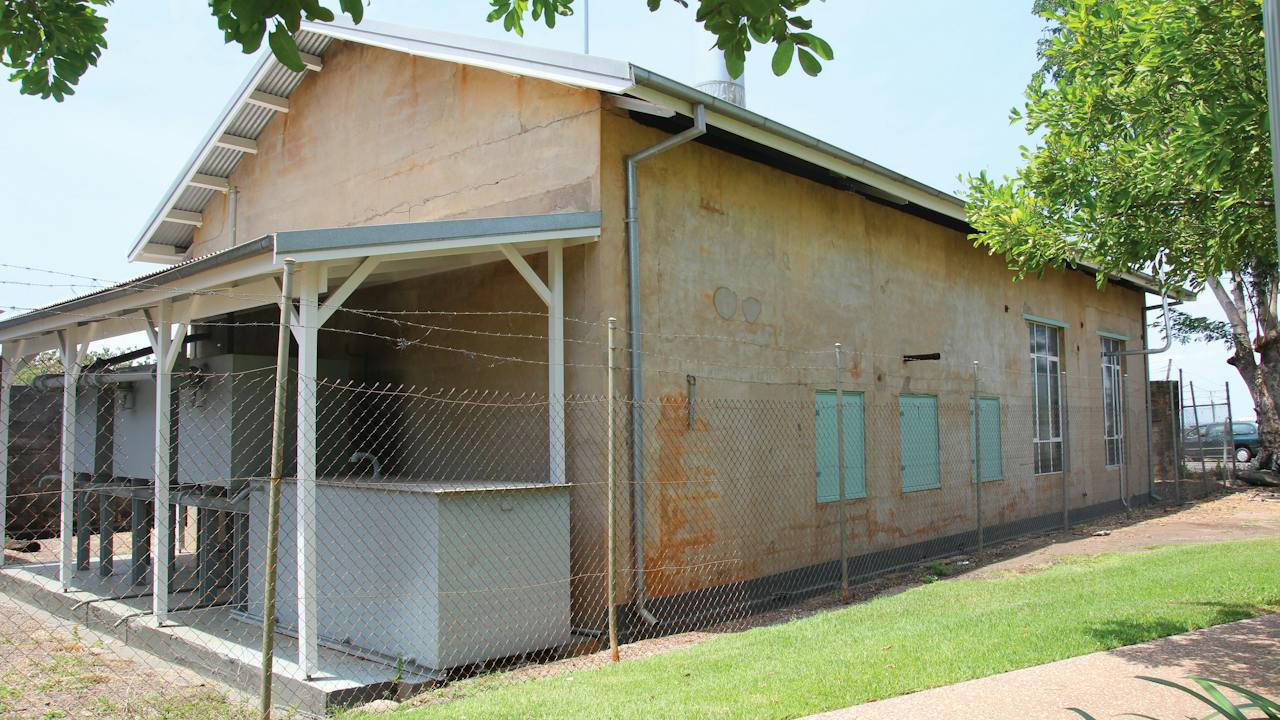
The steam pump house is a rectangular shed constructed of rendered blockwork walls. A metal truss roof supports gabled corrugated iron roof. There are additional concrete walls on all but the western side (the building originally abutted a hillside on the west) built as blast barriers. The building houses a travelling crane gantry, boilers and two steam driven duplex pumps with connecting oil pipelines to pump oil to and from ships and onshore storage tanks. The pump house was constructed in 1927-28.
The construction of this oil fuel installation, together with the transfer of a Garrison to defend the installation, was the beginning of the major expansion of Darwin as a defence base. This military build-up was central to Darwin's development from a small outpost into a thriving city.
This tree is significant due to its historic, social and aesthetic values. This Boab marks the site of Darwin's first primary school, and later the Darwin High School and the Adult Education Centre. This Boab was planted in the late 1800's and is a fine example of its species. During WWII a "Daisy Cutter" bomb lay unexploded within its shade for several days prior to discovery.
The Darwin City Geotrail is a self‑guided 6.5 kilometre walking experience through the Darwin CBD, Esplanade and Waterfront, showcasing over 70 points of geological, historical, cultural and scenic interest.
Visitors explore dramatic rock formations, monsoon forest pathways, elevated harbour lookouts, World War II heritage sites, and key landmarks that reveal the origins, evolution and contemporary character of Darwin.
Suitable for families and day visitors, the trail highlights Indigenous heritage, early settlement, wartime history and the city's unique tropical landscape, offering an engaging way to discover Darwin at a relaxed pace.
Lyons Cottage is the only remaining example of colonial bungalow style architecture in Darwin. This simple cottage is built from locally quarried porcellanite stone, timber from Asia and slate roof tiles from England and was constructed in 1925 for the Eastern Extension Australasian and China Telegraph Company, successor to the British Australia Telegraph (BAT) Company.
Initially home to the telegraph company's engineer, the cottage was leased to prominent lawyer and politician John 'Tiger' Lyons in 1948. In addition to having a highly successful legal practice, Lyons was a Mayor of Darwin in 1958-59 and served in local government until 1963 when he was elected to the Legislative Council where he served until 1968. He died in 1970. Dorothea Lyons remained in the home until 1972 when she sold the lease to developers who proposed to demolish the cottage and build a high-rise hotel on the block.
The cottage was seriously damaged in Cyclone Tracy after which the developers abandoned their plans. Lyons Cottage was proclaimed an historic reserve in 1978 and was acquired by the NT Government in 1984.
Goyder Park commemorates Goyder’s Camp, which is of historical significance as the first settlement within Port Darwin from which would grow the modern city of Darwin.
Woodroffe Goyder, Surveyor General of South Australia, landed at an area between Fort Hill and the Darwin escarpment on 5 February 1869. From this location, Goyder’s party surveyed the city that would become Darwin and eight other townships along Northern Territory waterways between February and September 1869. The camp continued to be occupied following the departure of Goyder during the early years of settlement and expansion within Darwin.
The camp area is also of historical significance as the landing point for the submarine telegraph cable between Java and Darwin that linked Australia to rest of the world in 1871 through telegraphic communications, and was the site of the original Overland Telegraph Camp.
Come on down to Aqua Park at the Darwin Waterfront where you will experience an adventure like no other in the NT.
Swim, run, jump, flip, climb, bounce and slide your way through four metre high floating inflatable obstacles that will leave you laughing and wanting to come back for more.
Located in the heart of Darwin City, Crocosaurus Cove is home to the world’s largest display of Australian reptiles, including the iconic saltwater crocodile.
Discover each of Crocosaurus Cove's 10 interactive shows daily, and learn all about Australia's incredible wildlife. Watch a huge saltie dine on his lunch during the Big Croc Feed Show, cuddle a snake or lizard during the Meet the Reptiles Show, and feed a feisty juvenile croc from the Fishing for Crocs platform. Then, capture a family photo with Fluffy the baby croc, or go for a dip in the Swim with the Crocs pool.
Crocosaurus Cove is also home to the famous Cage of Death, Australia’s only crocodile dive. Swim with one of the largest saltwater crocs in the world, and marvel at his prehistoric features and mesmerising gaze. This is a truly up close and personal experience that must be done.
Don’t miss Crocosaurus Cove, Darwin’s ultimate urban wildlife experience.
Frog Hollow is highly valued by the Darwin community for its social, industrial relations and educational associations. It is valued as natural parkland in the central city area.
It was used as worker camps in the early years of Commonwealth jurisdiction over the NT from 1911. Living conditions were squalid and described by the Northern Standard as ‘humpies’ and ‘bag huts held together by wire’. Frog Hollow had a single tap, no toilets and mosquito-infested water pools.
By 1936, private houses were being constructed at Frog Hollow. In 1938, however, land was compulsorily acquired by the Commonwealth for military uses, including construction of a 200,000 gallon petrol tank for piping fuel to the jetty, and installation of a drainage system. A workers camp remained until the bombing of Darwin in 1942 when all land was acquired by the military. A fuel tank at Frog Hollow was destroyed in a bombing raid on 2 April 1942.
In 1949, a parliamentary inquiry recommended that a school be built on land adjacent to Frog Hollow to support the rapidly growing post-war population. Darwin Primary School opened in 1954 and closed in 1984. The buildings are now used for community arts.
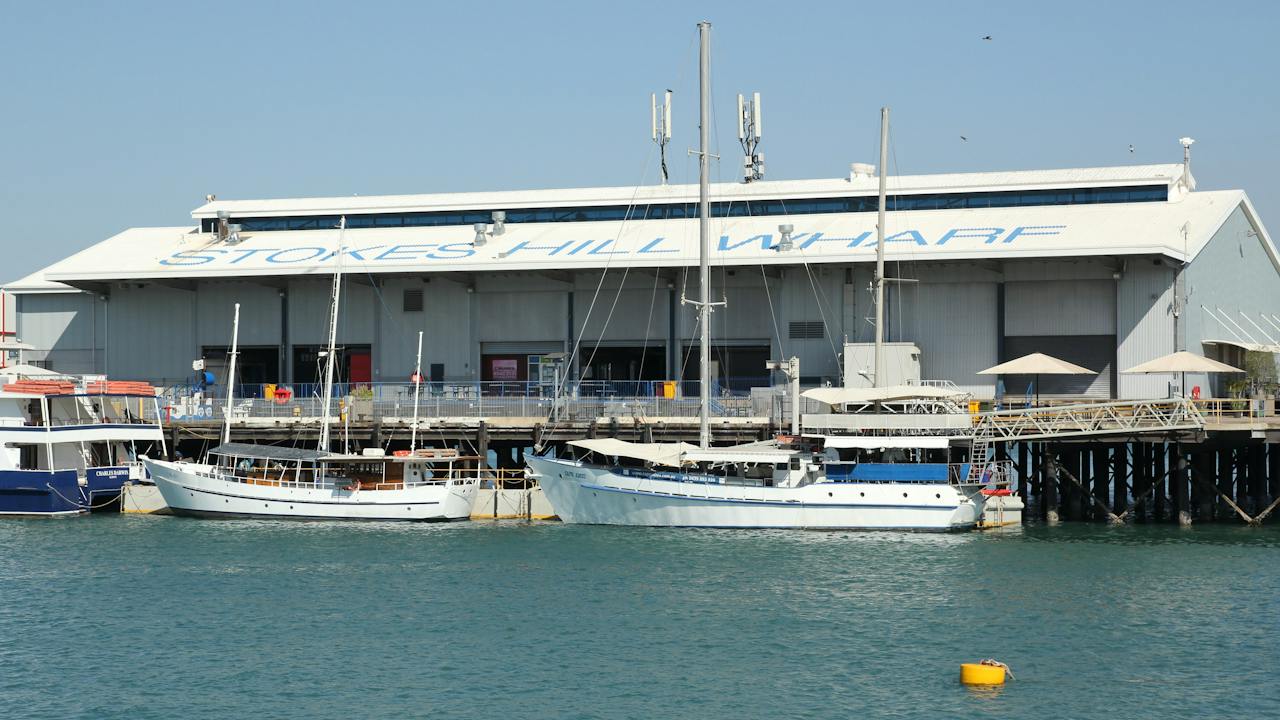
The historic Stokes Hill Wharf offers a relaxed friendly atmosphere with seaside alfresco eateries, restaurant dining, a spot to fish and is a hub for various cruises and tours on beautiful Darwin Harbour.
Enjoy a spectacular seaside alfresco lunch or dinner with an array of cuisines to choose from for in the food courts, or a delicious steak or seafood dinner at Crustaceans Restaurant, open 7 days.
There is an affordable bar with a great selection, a playground, a free waterfront shuttle that operates during lunch and dinner, or take a Beam e-scooter to get you there.
The Royal Flying Doctor Service Darwin Tourist Facility and Bombing of Darwin Attraction is a must whilst visiting Darwin. Constantly ranked as number 1 of things to do in Darwin on Trip Advisor. This attraction showcases two iconic stories in the one location, the Royal Flying Doctor Service which began operations in the NT in 1939, and the Bombing of Darwin in 1942.
Stokes Hill Wharf is open to enjoy year-round panoramic views of Darwin Harbour and sensational sunsets, fish feeding at night and free live entertainment on Wednesday and Sundays from 6pm during the Dry Season (May to September).