Tasmanian chain-saw artist Eddie Freeman has released these historical figures from their imprisonment in the Windmill Point macrocarpa trees.
The sculptures depict workmen hauling ashore the telegraph cable that linked Tasmania to the North Island, the cable station was the messaging hub of the state until 1909. Matthew Flinders with his cat Trim, George Bass, and Colonel William Paterson are also represented.
The site also has a BBQ and a playground featuring a wooden boat named after the HMS Buffalo - the ship that Paterson landed in 1804.
Enjoy a relaxed, accessible riverside stroll on Gilgandra's Windmill Walk. This two-kilometre (one-way) path links the Coo-ee Heritage and Visitor Information Centre with the Gilgandra CBD and follows the Castlereagh River through native flora, birdlife and peaceful country scenery.
Along the way, discover historic windmills brought back to life with bright artworks created by local disability services – a colourful highlight that celebrates community spirit. The walk is pet friendly, family friendly and offers picnic facilities for an easy outdoor break.
The Windmill Walk is also a popular community route, used weekly by the Gil Run Club and as part of the annual Colour Run during Goin' to Gil weekend. It's an inviting, scenic and accessible way to experience the Gilgandra Region.
Windows to Our History is a collaborative project between Edward River Council and Deniliquin Business Chamber.
The project shines a light on some lesser-known characters and events from Deniliquin's history, with a series of stories told and illustrated by local artist Sivonne Binks and brought to life by local business VisAttak. With colourful characters such as Cyril Gove and his historic day competing in three different sports and Aileen Dent, a celebrated artist of Archibald fame, and the dashing bushranger Captain Melville, the eye-catching artworks will give an entertaining window to our history for locals and visitors.
The decals are installed at various shop facades in Napier and Cressy Streets, with a flyer available at the Deniliquin Visitor Information Centre. At any given time there may be in excess of three shop window 'Windows to our History' installations.
Windsor is located about 50 kilometres north-west of Sydney and is one of the oldest European settlements in Australia. The historic charm of Windsor can be explored on our self-guided heritage walks.
Today, visitors can wander through this charming town known for its impressive collection of heritage buildings, some designed by convict architect Sir Francis Greenway, including St Matthew's Anglican Church and the Windsor Courthouse. While you're here, take time to visit St Matthew's Cemetery, where notable Hawkesbury figures are buried, including John Tebbutt, Dr Thomas Arndell, Captain John Babryn and William Cox.
You can collect a free Heritage Highlights booklet from the Hawkesbury Regional Museum or the Hawkesbury Visitor Information Centre in Richmond. Please note that many heritage buildings are privately owned and can only be viewed from the street.
On a global windsurfing stage, Geraldton is rated among the best for its idyllic and uncrowded conditions – what’s more it’s also home to top class surf spots.
Grab your board and set sail for the thrill of a lifetime at one of the many spots along this pristine slice of Western Australia.
For windsurfers the best conditions are between November and April when gale force winds challenge the most experienced wave sailors and nurture the novices. The strongest breezes happen in mid summer and are ideal for high-speed slalom racing.
Point Moore and St Georges Beach are the best known windsurfing locations. Beginners head here in the late morning while high winds in the afternoon attract the regulars.
Surfers won’t leave Geraldton disappointed.
The shore break at Back Beach is well known for its consistent swell. Other popular spots for surfing include Coronation, Medallia, Pages, Point Moore, Separation Point, Sunset and St Georges beaches.
For more information about wind and wave conditions contact the Geraldton Visitor Centre.
Geraldton is a five hour drive or one hour flight from Perth.
A trip to Windy Harbour and Salmon Beach offers several activities to ensure a memorable visit. Take a pleasant scenic drive to the lighthouse on the edge of the harbour for exceptional panoramic views of the coastline.
Cast a reel into the ocean from Salmon Beach, enjoy the surrounding D’Entrecasteaux National Park and camp overnight at Windy Harbour.
Located 16 minutes drive south of Northcliffe and 4.5 hours south of Perth, Windy Harbour and Salmon Beach are the only coastal locations in the area accessible by two-wheel drive vehicles. Make sure to collect your food and camping supplies in the town before heading to the coast.
Tourists are advised to check for alerts and road/park closures before commencing their travel on www.emergency.wa.gov.au and https://alerts.dbca.wa.gov.au.
Windy Hill Wind Farm is Queensland's largest wind farm with 20 windmills producing enough power for 3500 homes. Windy Hill Wind Farm is located about three kilometres from Ravenshoe, which is situated 920 metres above sea level (highest town in Queensland) on privately owned Atherton Tableland dairy farmland. It is capable of a generating capacity of 12 megawatts, and the number of wind turbines is 20.
Windy Station is located on the vast and abundant Liverpool Plains region of northern NSW. The region boasts the most fertile soils in Australia and is surrounded by a unique blend of year-round food and fibre production.
Beef, cotton, and grains are produced at Windy Station, which is also home to the famous state heritage list Windy Station Woolshed, built in 1901. Visitors from far and wide are welcome to explore the stunning array of colours from the sunflowers to red sorghum, wander through 120 years of history in the woolshed, wake up to the sunrise in the refurbished shearers quarters, or spend an hour touring the farm with one of the farmers and learning about Australian agriculture across 65,000 acres!
Windy Station is located an easy 4.5 hours north of Sydney, three hours north west of Newcastle, or an hour from Tamworth airport, linking it directly to Melbourne, Sydney, and Brisbane.
Windyridge Gardens at Mount Wilson dates from 1877, with the first planted tree, a Swiss Christmas Tree (Abies amabilis) in August 1945. Now the garden includes Cedrus deodara, copper beech, pin oaks, maples, ginkos, azaleas, rhododendrons, dogwoods and nyssas.
During Easter 1995, Rodger and Wai Davidson, of Davidson's Nurseries at Galston, in Sydney, purchased Windyridge to accommodate their expanding collection of cold climate plants. Work commenced under Wai's supervision to transform Windyridge into a grand garden. After tree maintenance work, Landscape Architect Gordon Sykes was retained to terrace and plant a vast grassy slope and give substance to the new owners' vision.
Mount Wilson is just two hours northwest of Sydney, 3,000 feet (1050 metres) above sea level and ringed by cool green rainforests.
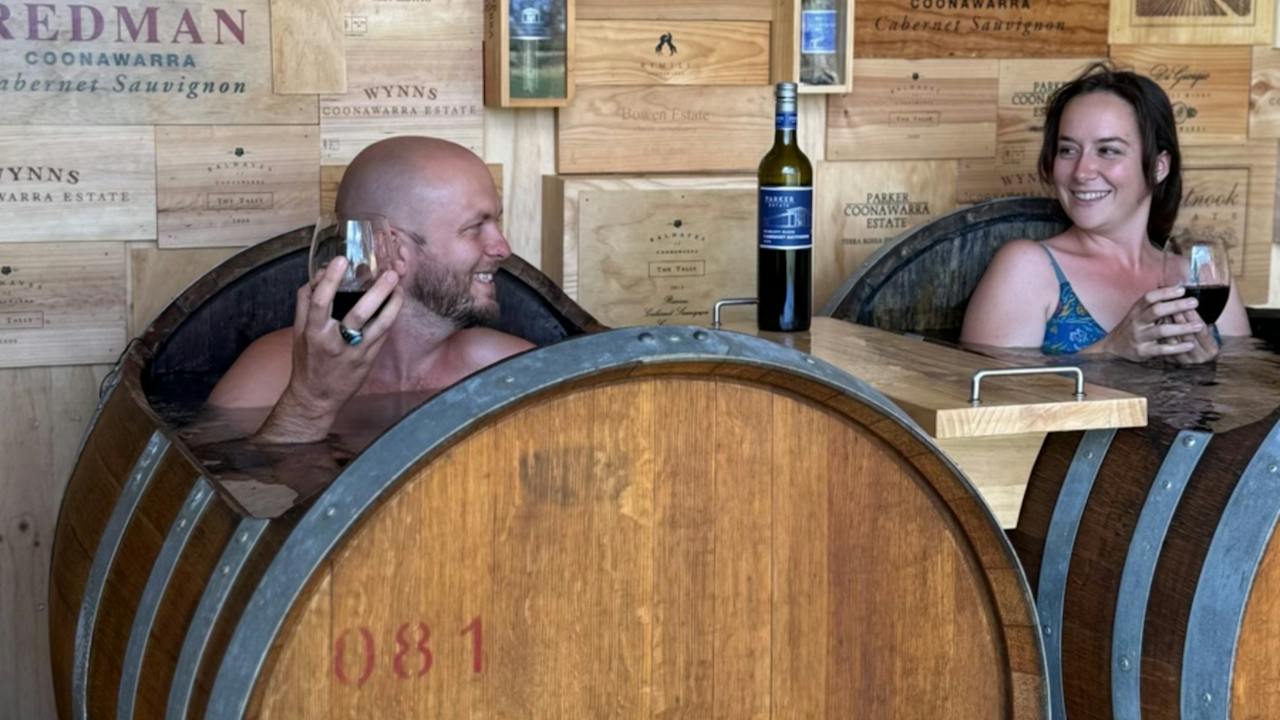
Penola Coonawarra Caravan Park in Penola, South Australia, offers a Wine Barrel Bath experience for adults seeking relaxation in the heart of wine country. This experience invites visitors to unwind in handcrafted baths made from reclaimed wine barrels, creating an escape surrounded by nature.
Each private session is designed for two people and includes a complimentary bottle of local wine, adding an authentic sense of place. Warm water, quiet surroundings, and rustic craftsmanship create an intimate setting ideal for couples, friends, or special occasions. The use of real wine barrels pays homage to the region's winemaking heritage, while the emphasis on privacy and comfort ensures a calm, unhurried experience.
Located within the renowned Coonawarra wine region, the baths are positioned close to cellar doors, scenic cycling and walking trails, and the historic township of Penola. Visitors may explore nearby wineries, enjoy local cafés, or take in the surrounding countryside. Designed with sustainability and local character in mind, the Wine Barrel Baths reflect the history and landscape of the region.
This experience is available to both internal and external guests. Each bath is pre-filled and heated prior to arrival and maintained at a comfortable soaking temperature for a 45-minute session. For water quality and maintenance purposes, the use of shampoo, body wash, soaps, or other bathing products is not permitted. Change rooms are available nearby.
Wine Body & Spirits (formerly Yoga in the Vines) is a mobile business, curates bespoke individual wellness experiences and/or blended wellness and wine signature experiences for corporate and private groups across the Hunter Valley.
At the heart of every experience is a philosophy of balance. Wine Body & Spirits invites guests to embrace a realistic approach to wellbeing, one where a glass or two of wine sits comfortably alongside yoga, pilates, meditation or sound bath and mindful self-care, free of guilt.
Sessions are gentle and welcoming for every level, designed to stretch, restore and quiet the mind before a big event or during a weekend away, with guests having the option to add a "sip session" and settle in to savour the region's celebrated wines.
From corporate retreats and team gatherings to weddings and hen celebrations and weekends away with friends, each experience is thoughtfully tailored to the occasion and hosted to leave guests feeling refreshed, connected and well looked after.
Walk to one of Tasmania's most celebrated views—the crystal-clear waters and curvaceous white beach of Wineglass Bay. The most traversed track inside the National Park, this 1.5-hour walk is the must-do when you visit Freycinet.
A beautifully constructed track takes you up through coastal woodland, past striking granite boulders, to the lookout. This is a steep uphill walk—around 1.3km each way—so walkers are advised to take advantage of the resting seats found along the way.
Once you're at the saddle, it's not far to the lookout platforms and a view that will reward your effort. An occasional bonus for some is the sight of whales or dolphins in the bay. This walk is best done in the early morning and afternoon to avoid the busy midday period.
National Parks Pass is required.
Grade 3, steep tracks, supervise children.
Wing Hing Long was established in Tingha in the late 19th century and operated as a general store through to early 1998.
In 1918, Jack Lowe became the owner of the store, and it remained in family ownership until the end. Mavis Pratt, Jack's daughter, took over management and ultimately ownership, and continued in that position until her retirement in 1998.
Jack Lowe was the fifth Chinese owner of the property. The first was An Lin from Inverell who purchased the land in 1881. The other owners were Jock Sing of Glen Innes, Ah Bow and Charles Hing from Tingha.
The Store is now open as a living museum and is maintained as much as possible as it was in early 1998. Stepping into Wing Hing Long today, you experience the rise and decline of a tin mining town and community, the flavour of a rural general store from early in the twentieth century and the importance and diversity of the contributions made by Chinese Australians to rural commerce and life.
Devonshire Tea is also available for a fee.
To build up an appetite or to walk your food off afterwards, take a stroll along Wingecarribee River walking track, which begins and ends at Cecil Hoskins picnic area. The track is a short easy walk that’s flat with few obstacles and no stairs, so it’s ideal for all age groups.
The track takes you west along the river past Bong Bong weir, then loops back through regenerating forest on Wingecarribee floodplain. You’ll see various types of eucalypts as you follow this walking track, including the less well-known gums, like snow, swamp, black sallee and manna eucalypt trees.
Keep your binoculars in easy reach for birdwatching. Through the forest, you may see woodland birds such as white-throated needletails, welcome swallows and spotted pardalote. Eastern grey kangaroos also inhabit the forest. And did you know you can find platypus shyly hiding in the lagoon?
Located in the Southern Highlands of NSW, Wingello Forest Campground is a fantastic place to visit for an overnight stay. The campground itself is surrounded by radiata pine forests, and offers a children's nature playground, picnic faiclities, toilets and access to mountain bike trails - all of which are free to use.
Wingello Forest Campground can be found in WIngello State Forest.
As you journey towards Murrurundi from Muswellbrook, the scenic route unveils vibrant murals on signal stations along the railway line. In Wingen, New South Wales, the Australian Rail Track Corporation (ARTC) organised a striking mural on the Hunter Valley Network railway’s signal and communications box.
The ARTC collaborated with Dan Bianco, an artist from Newcastle, to bring this mural to life. Bianco drew inspiration from Wingen's community, engaging locals in a workshop and afternoon tea to delve into their cherished aspects of the landscape, history, and wildlife in the area.
The mural encapsulates the connection Wingen has with its natural environment, showcasing indigenous flora and fauna. Notably, it pays homage to the Wingen Maid, a rock formation within the Wingen Maid Nature Reserve that, when viewed from specific angles, resembles the silhouette of a woman—a spiritual and significant symbol in Wonnarua culture.
Furthermore, the mural vividly portrays the historical significance of rail in Wingen. Before the construction of the Ardglen tunnel in 1877, Wingen served as a pivotal point along the rail line, playing an integral role in the network's operation.
The mural was unveiled in 2023.
Wingham Brush boardwalk and nearby walking tracks provide a gateway from which to discover the incredible world of plants, birds and flying foxes in the rainforest. The wheelchair friendly boardwalk is suitable for all ages, and connects with Graham Allen and Regenerators walking tracks.
Continue along Flying Fox circuit and you’ll find yourself standing directly under the flying foxes' roosting site. Learn something new from the signage along the way, or just admire the gigantic Moreton Bay fig, stinging, and white cedar trees. Keep your eyes out for land mullets and brush turkeys in the undergrowth and listen for the distinct calls of the green catbird and wompoo fruit-dove.
Why not pack a picnic, make a day of it and enjoy picnicking, swimming and fishing at the adjacent Wingham River Park? Then, sit by the banks of the river and watch the flying foxes flying out at sunset.
Located beside Manning River, just near Taree on the Mid North Coast, you'll find an oasis of subtropical lowland rainforest at Wingham Brush Nature Reserve. It provides a fantastic day trip and excursion for the whole family.
Also known as The Brush', this reserve preserves one of only a few remnants of this rare rainforest type in Australia, and is a significant roosting and maternity site for the vulnerable grey-headed flying-fox. Stand under the canopy and you'll see hundreds of flying-foxes hanging above you.
Wander along the wheelchair-accessible boardwalk and follow easy walking tracks to discover the vibrant life under the canopy. There are great opportunities for photography and birdwatching, and lovely places to picnic by the river nearby. Don't miss the spectacular show at sunset, when all those flying foxes glide overhead in search of food.
Wingham was the first government town established in the Manning area. The village was proclaimed in 1844, three years after the first land grant to Mr George Rowley. The first grant was located in the bight of the river above Wingham, now known as Bungay.
This self-guided walk around Wingham highlights several built and natural items of significance to the history of the village. The walk is approximately five kilometres. Allow up to two and a half hours to visit all the items of interest. Remember to take drinking water and wear comfortable shoes.
You may also like to allow time to visit the many cafes and shops along the route or stop beside the river in Wingham Brush for a picnic lunch.
Wings Wildlife Park is a multi-award winning family owned business and displays the largest collection of Tasmanian wildlife in Australia.
Located less than a one-hour drive from the Spirit of Tasmania ferry terminal in Devonport. Situated in Gunns Plains, 23 km south of Ulverstone, in the beautiful northwest of Tasmania, on the banks of the Leven River.
Your visit to Tasmania is not complete unless you get to see some real live Tassie devils up close. The devil feed is at 1400 daily, koala presentation at 1100 and 1430, meerkats at 1130 and reptiles at 1330. You can feed the trout and the friendly kangaroos.
Other animals you can see at the park include wombats, wallabies, quolls, sugar-gliders, wedge-tail eagles, reptiles, meerkats, marmosets, monkeys, bison, camels and much more.
Most native animals at Wing's Wildlife Park have been rescued following injury and are released into their natural habitat when rehabilitated. Those unable to be released stay in care for the remainder of their lives.
Group bookings, guided tours, encounters, catering, camping and backpacker accommodation are available.
Wing's Wildlife Park has a cafe which you can access separately to the wildlife park. It is open for lunch, snacks, drinks and ice-creams. You can browse in the gift shop and find that treasured souvenir.
Wings'n'Roses is a unique parrot-focused sanctuary, home to over 200 colorful parrots, with a special emphasis on hand-raised parrots that are friendly, interactive, and close to people. They also feature rare hand-raised owls for an unforgettable experience.
During the Exotic Parrot Encounter, you'll get up close with some of the sweetest, hand-raised parrots as they perch on your arm for unforgettable photos, nibble treats from your hand, and fill the air with vibrant colour as they fly around you. It's an intimate, interactive experience designed to let you meet these beautiful birds the way we know them—curious, playful, and full of personality.
Open throughout Christmas and New Year, Parrot Rose Garden is the perfect festive destination to enjoy the charm, intelligence, and beauty of parrots up close.
Is a 75-hectare private nature reserve located two kilometres south of Scamander. It is named after Tasmania's most esteemed botanist.
The reserve is the last intact remnant of dry sclerophyll bushland, marshland and heathland in the Break O'Day Municipality, unchanged since the time of European settlement in the early 1820's.
There are over 300 species of native flora and 80 species of birds, both land and waterbased.
There are over 7kms of easy walking tracks encompassing the 16 ecosystems. There is also a vehicular road enabling limited access.
It is free to walk in the Reserve to admire the plants and flowers but please do not damage them. Off road vehicles are not permitted. No camping, fires or collection of firewood; no hunting or shooting and of course no littering. Dogs are allowed on the tracks but on a leash or under close sight control.
The Winmark Art Gallery is an art lovers wonderland amongst Winmark Wines Cellar Door, sculpture park, gift store, coffee cart and event space and is located just a stones throw from the historic village of Broke in the Hunter Valley.
Winmark is a unique celebration of wine, art and nature and is a must visit destination when in the Hunter Valley.
Owner and vigneron Karin Adcock has always been a passionate art collector, and has now been able to realise a long held dream of curating a gallery introducing some of the amazing Artists and Sculptors discovered through her travels.
The Gallery is proudly representing Rebecca Pierce, Felicia Aroney, James Ainslie, Erik Flygenring and Sculptors David Ball, Michael Purdy, Ulan & Rachel and Katarina Wells to name but a few. With sales of these pieces steadily growing throughout the day, Winmark Wines are looking forward to regularly adding new pieces to the Gallery from these artists, and indeed Karin will no doubt be discovering more talents on her journeys that she will wish to share with all.
The Winmark Art Gallery was officially opened on 13th February 2021, by Danish Ambassador Pernille Dahler Kardel.
A coffee cart and wine tasting room sit alongside the gallery.
Spanning 130 exquisite acres in the heart of the Hunter Valley, Winmark is not just a premium Chardonnay producer but a destination. Owner and Vigneron Karin Adcock have been avid collector of art and sculptures. ‘Biosis’ is another of David Ball’s monumental sculptures in the series with Fissure, and now finds its home at Winmark.
David Ball’s monumental Biosis was the first of many sculptures to find their home at Winmark, and with David’s view that “Wine and Sculpture both age well” it is delightful to see a second sculpture from his series ‘Celest’ being the latest installation. It will keep fine company along with the People’s Choice sculpture ‘Fight or Flight’ exhibited at the Wollombi Sculpture Festival that now resides at Winmark.
Newly installed Ceramic Lollipops and the red Portals of Illusion, join Bronze Flower, Field of Aggies, Paper Rock Scissor and Ceramic Totem Poles scattered across the property. Winmark is also home to natural landmarks of historical significance.